Boss GT-1 Field Report
A Versatile Multi-Effects Unit for Beginners with Great Sound
Roland has offered the Boss GT-1, a multi-effects unit for guitar beginners, for several years. It offers the same sound engine as the GT-100, which is twice as expensive, but it is available at an affordable price.
What compromises must beginners make? Is it worth paying the higher price compared to other beginner devices? In our review, we take a closer look at the GT-1 to find out.
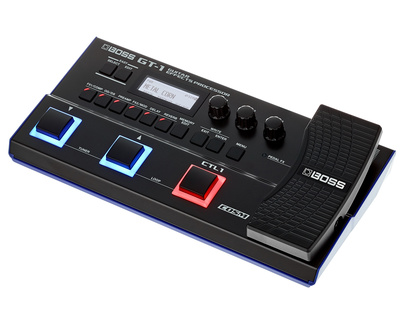
Features and technical data
Memory slots
The GT-1 offers 108 effects to choose from in its floorboard-style housing. These effects can be combined into patches, and the device can store up to 99 of them. In addition to user-defined patches, Roland pre-installs 99 presets, covering numerous styles and sound preferences. The included patches cannot be deleted; however, due to the generous storage space, this does not have a negative impact in practice.
Switches and Connections
In addition to its internal features, the GT-1 impresses with its black-and-blue housing, which has no sharp edges. The device measures 30.5 x 15.2 x 5.6 centimeters, weighs 1.3 kilograms, and has three large foot switches on its top panel. These switches can be used to navigate between patches and switch between sounds, such as rhythm and solo, within a patch. An integrated expression pedal is located on the far right of the GT-1. You can control the respective effect types of a patch directly via six smaller, illuminated buttons. Three rotary controls allow you to adjust the values shown on the backlit display.
You can connect your guitar to the back of the GT-1 and expand the device with optional pedals via 6.3 mm jack connections. There is an additional input in the form of a small jack. This allows you to connect audio sources, such as MP3 players, and loop them directly into the output. The GT-1's output can operate in stereo via two 6.3-mm jack connectors. The left jack can be used alone as a mono output. You can also connect headphones via a mini jack. The GT-1 can be connected to a PC or Mac via a USB port.
Power supply
However, we find the power supply options for the GT-1 to be somewhat limited. The included four AA batteries allow the GT-1 to operate for just under seven hours, which is significantly less than competing devices. There is a power connection on the back of the GT-1, but the appropriate power supply is not included in the sales package. If you want to operate your GT-1 via a power supply, you must pay Boss an additional 30 USD.
Tuner and looper
Boss has equipped the GT-1 with additional features: a tuner and a looper. The tuner can be activated by pressing the up and down buttons simultaneously. It shows on the display whether the string is too high or too low using a scale and the illumination of the large foot switches. Similarly, the looper can be activated by pressing the middle and right foot switches simultaneously. It records up to 32 seconds of your playing and allows you to layer multiple recordings.
Effects and Presets
With 108 different effects, the Boss GT-1 can adapt to virtually any desired sound. Despite its significantly lower price, the GT-1 uses the same sound engine as the GT-100, as previously mentioned. Boss refers to this engine as its "flagship." Accordingly, we believe the GT-1's sound quality is exceptional.
The effects are divided into six categories, each of which is represented by a button on the device. They can be configured in detail.
FX1: Configurable: e.g., compressor, wah-wah, octave, or chorus
OD/DS: Overdrive or distortion
PREAMP: Preamplifier
FX2/MOD: Configurable effects, e.g., compressor, flanger, phaser, or limiter
DELAY: Delay effect/echo
REVERB: Reverb
With its 27 preamp settings, the GT-1 offers a wide variety of simulated amplifiers. Here are some of the highlights:
HiGAIN STK: A high-gain stack based on Marshall amplifiers.
JC-120: Simulation of Roland's JC-120 amplifier
CLEAN TWIN: Fender Twin Reverb
TWEED: Fender Bassman
BG LEAD: The sound of a Mesa/Boogie combo amp
T-AMP LD: Hughes & Kettner Triamp AMP3
ORNG ROCK: Orange Rockreverb
With 22 effects, the range of overdrives and distortions should leave nothing to be desired for beginners. In this category, the Boss GT-1 offers the following, among other things:
BLUES OD: Crunch sound of the Boss BD-2
OD-1: Simulation of the Boss OD-1 distortion device
RAT: Proco Rat
GUV DS: Marshall Guv'nor
DST+: MXR Distortion +
60S FUZZ: Simulates a Fuzz Face
If you're a beginner who would rather use preset patches than create your own, the GT-1 offers 99 excellent-sounding variants. The presets cover a wide range of genres and techniques. For example:
HI GAIN STACK: Powerful hard rock sound
AC SIM STRAIGHT: simulates the sound of acoustic guitars.
FAT BLUESY LEAD: Blues lead sound
GREAT ROCK: Hard rock sound of the '90s
MODERN METAL: Powerful metal sound for riffs and solos
FUNKY GROOVE: A sound for jazz/funk strumming.
COUNTRY PICKIN': Classic country sound
We have no complaints about the sound quality of the effects and presets. Clearly, Boss incorporated the sound engine from its more expensive devices into the GT-1, which is a definite plus. The GT-1's acoustic guitar simulation is also noteworthy, as it's often difficult to digitally simulate acoustic sound. However, with the GT-1, Boss has managed to create a very convincing simulation.
Take a closer look at the effects and preset settings in this PDF from the manufacturer to see the many sound possibilities the GT-1 offers.
Operation
Despite its many effects, we found the Boss GT-1 simple and intuitive to operate. Most people should be able to figure it out without studying the included manual. Don't worry about reading the 12-page manual before using the Boss GT-1, though, because it's more like a booklet than a book.
After turning it on
The device turns on or off automatically when you connect or disconnect your guitar on the back. After switching it on, the GT-1 enters play mode, allowing you to start playing right away. You can select the current patch by pressing the left and middle foot switches, or by turning the left knob. Depending on the patch, the right foot switch (CTL1) has different functions, but it is usually used to switch between rhythm and lead sounds.
Adjusting and changing effects
The patch effect chain is represented by six corresponding buttons on the device. Each button has a red LED that lights up when its respective effect type is active in the patch. To change an effect's parameters, press and hold the corresponding button until the display changes. You can then adjust the values using the three knobs.
The three knobs are an integral part of the GT-1's operating concept. The bottom of the display always shows what can be changed using the knobs in the appropriate order. An Easy Select button located at the top right of the device allows you to select a patch by genre. The adjacent Easy Edit button takes you to a mode where you can directly adjust the Tone, Vibes, and Echo settings using the three knobs. This further simplifies operation.
Connect the BOSS GT-1 to a computer
The GT-1 can be connected to a PC or Mac via a USB cable. Boss provides the free Tone Studio application for this purpose, which allows you to manage your presets on a larger screen. A special feature of Tone Studio is that it allows you to download and install new presets from the Tone-Central-Website. There, you can choose from patches of numerous well-known guitarists, such as Marty Friedman and Herman Li. They even briefly introduce their patches in corresponding videos.
Conclusion
The Boss GT-1 produces sound quality that should satisfy even the most advanced users. In our experience, its impressive array of effects and settings leaves nothing to be desired for beginners. Overall, the device is pleasant to use, and the Tone Studio is a useful addition for easily editing patches. The only drawback is that Boss did not include a power supply with the multi-effects device. This seems like a hidden cost, as most users will probably need to purchase a power supply separately. If you decide to buy the GT-1, be sure to factor in the cost of a power supply.
Overall, the GT-1 is an excellent pedalboard. Despite its rather high price of around $200 for a beginner's device, it's well worth the investment. If the GT-1 is within your budget, you can't go wrong. Thanks to its good sound quality and well-designed controls, the GT-1 is a smart choice for the rehearsal room and your first gigs.
More reviews
Publish date:
Last updated: