Headrush Pedalboard Field Report
A superb, high-end multi-effects device!
In July 2017, the manufacturer introduced the "Pedalboard," a device that can hold its own against the flagship products of well-known brands like Boss and Line 6. Today, we take a closer look at this professional-grade device, which is priced at just under $950, and demonstrate its features.

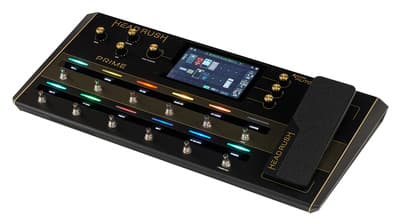
Update: Unfortunately, the Headrush Pedalboard is no longer available. If you would like to learn more about its successor, the Headrush Prime, please read our review. You can purchase the Headrush Prime using the links above.
Features and Technical Data
This stylish, black, steel case measures 61 x 30.5 x 8.9 cm and weighs over seven kilograms. Therefore, it will not fit in your guitar gig bag. In fact, the manufacturer offers a separate gig bag for the pedalboard as an optional accessory. However, given its features, which are presented in the following paragraphs, the weight is not surprising for a floorboard device.
The pedalboard has twelve footswitches on top, a large expression pedal, and a seven-inch touchscreen display, which is larger than those of other manufacturers' devices. Each footswitch has its own small display that labels its functionality and is complemented by a colored light strip. This helps you immediately recognize the type of effect.
The pedalboard is impressive under the hood, too. It has a quad-core processor that runs an updated version of the Eleven Rack software found in Pro Tools. You may be wondering why Pro Tools software from Avid is on a Headrush device. Here's the answer: A few years ago, inMusic, Headrush's parent company, bought parts of Avid that the manufacturer wanted to get rid of due to poor quarterly figures. The companies therefore have a shared history, and rumor has it that the same team that developed the original Eleven Rack worked on the Pedalboard.
In addition to the standard features, such as amplifier and effects simulations, the Pedalboard has a useful looper. Unfortunately, it only supports recording a single track. However, with 20 minutes of recording capacity, there is enough space for lengthy compositions. In addition to the standard functions, the looper can halve or double the speed and reverse recordings.
Connections and Expandability
The pedalboard offers many connection options. As usual, there is a large jack on the front panel for connecting a guitar or bass, as well as a small jack auxiliary input. You can connect external foot switches via another large jack. On the output side, there is a stereo XLR output with left/mono and right connections. A small knob allows you to switch between ground and lift. Next to that is a stereo output with large jacks for left/mono and right, as well as a large jack for connecting headphones. A switch allows you to adjust the output levels for amplifier or line output by switching the stereo jack output to AMP or LINE.
In addition to the standard inputs and outputs, the Headrush Pedalboard has two FX loops (two sends and two returns) to integrate external effects devices or amplifiers into the effects chain. There is also a switch for this that adjusts the output levels for connection to racks or effects pedals. The pedalboard also includes a MIDI input and output. The output can also function as a MIDI thru connection.
The device can be connected to a PC via a USB-B port. Unlike most multi-effects devices, there is no dedicated editor software for the pedalboard for PC or Mac. When connected to a PC, the device appears as a USB storage device. Third-party impulse response files can be transferred to it via a file manager. The USB port also allows the pedalboard to be used as a USB audio interface. The manufacturer provides a Windows audio driver for this purpose in the “Downloads” section of the product website. The USB audio interface can record at up to 24-bit and 96 kHz.
Otherwise, the front of the pedalboard only has a three-pin connector for the power cable. The power supply is integrated directly into the device. Consequently, the pedalboard has a power button in addition to the power connection, eliminating the need to constantly disconnect and reconnect it to the power supply.
Overall, the Headrush pedalboard has the following connections:
Instrument input: 6.3 mm jack
Auxiliary input (3.5 mm jack)
Pedal connection (6.3 mm jack)
XLR stereo output (left/mono + right) with a GND/LFT switch
Stereo output (two 6.3 mm jacks, left/mono + right) with AMP/LINE switch
Headphone output (6.3 mm jack)
Two send and two return connections (FX loop) with RACK/STOMP switch
One MIDI input
1x MIDI output/MIDI thru
USB-B connection
An IEC connector is used for power connection
Overall, we think the connection options on the pedalboard are decent. Some competitors offer additional connections, such as more outputs, a dedicated MIDI Thru connection, or a second connection for pedals or foot switches. However, these options should be adequate for most users.
The only drawback is the lack of PC software, which other manufacturers offer for their multi-effects devices. That said, the pedalboard is very easy to use thanks to its integrated touchscreen. This means there's no need to adjust the device parameters on a PC or Mac. We will discuss this further in the “Operation” section.
Amp simulations and effects
The Headrush Pedalboard offers 46 amp simulations, all of which, in our opinion, sound great. Fifteen cabinets and ten microphones complement the sonic offerings. You can also transfer your own impulse response files to the device via USB and integrate them into the effects chain.
You can completely customize the arrangement of the effects on the Pedalboard to suit your preferences. The individual effect stations can be distributed across the twelve footswitches independently of the order of the respective effect in the signal chain. Fans of harder sounds have fifteen distortion and overdrive effects at their disposal. Additionally, 21 modulation effects, including chorus, flanger, vibrato, phaser, rotary, and octave shifter, offer variety in sound. The pedalboard offers twelve delay and reverb effects.
Below is a small selection of the simulated effects and amplifiers:
Fender Princeton Reverb (amplifier)
Fender '59 Bassman (amplifier)
Vox AC30 (amplifier)
Ampeg Portaflex B15-N
Marshall JCM-800 (amplifier)
Mesa/Boogie Mark IIc+ (amplifier)
Mesa/Boogie Dual Rectifier (amplifier)
Orange AD30HTC (amplifier)
Shure SM7 (microphone)
AKG D112 (microphone)
Ibanez TS808 (overdrive pedal)
ProCo Rat (distortion pedal)
Boss DS-1(distortion pedal)
Klon Centaur (distortion pedal)
Boss CE-1 (chorus)
TC Electronic Thunderstorm (flanger)
Boss TR-2 (tremolo)
Boss Acoustic Simulator (acoustic guitar simulation)
In our opinion, the sound quality of the pedalboard is consistently excellent and rivals that of professional multi-effects devices from industry leaders such as Boss, Kemper, and Line 6. However, some competitors offer a slightly wider selection of effects and amplifiers. Headrush clearly prioritizes quality over quantity. Nevertheless, the range of amplifiers and effects is extensive, and with some adjustment of the parameters, you should be able to find the right sound for almost any need. Support for IR files offers additional customization options.
Operation
Headrush got everything right when it comes to operating the pedalboard—better than most of its competitors, in our opinion. The generously sized touchscreen display is not a gimmick; it makes operation much easier. Essentially, you are dealing with an interface that rivals the operation of effects in common DAWs. You can rearrange the signal chain using drag-and-drop, and the effects are presented similarly to their physical counterparts.
We also like that it can be operated with your feet, freeing up your hands. Thanks to the twelve footswitches, you can activate all effects directly on top of the device. Press and hold a footswitch to open the parameters of the corresponding effect on the Pedalboard. Unlike other multi-effects devices, you can change the Pedalboard's values directly using an expression pedal. This means you no longer have to bend down to operate the device with your feet. While it may sound trivial, the fact that the Pedalboard can be operated entirely by foot is unique among multi-effects devices.
In our opinion, the 49-page online manual covers everything important and illustrates it clearly with screenshots and graphics.
Conclusion
The Headrush Pedalboard is an astonishingly successful first attempt by the manufacturer to introduce a multi-effects device to the market. The device consistently produces high-quality sound, and it offers a wide selection of amplifiers. While other manufacturers also offer good sound quality, the Pedalboard is particularly impressive thanks to its user-friendly operation, whether by hand on the touchscreen or by foot. With twelve integrated foot switches and the ability to adjust any value with an expression pedal, the foot control is arguably the best on the market.
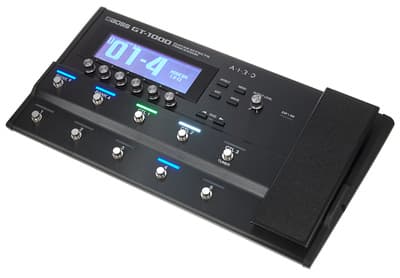
When buying a device in this price range, it's important to consider the competition. We recommend taking a look at the Kemper Profiler Stage, the Line 6 Helix LT, and the Boss GT-1000, all of which we have reviewed in previous articles. However, as long as you like the sound of the device and don't need a PC editor, you can't go wrong with the Headrush Pedalboard. If you enjoyed working with the Eleven Rack, the Pedalboard is definitely worth considering.
Update: Unfortunately, the Headrush Pedalboard is no longer available. If you would like to learn more about its successor, the Headrush Prime, please read our review. You can purchase the Headrush Prime using the links above.
More reviews
Publish date:
Last updated: