Headrush Prime - Test & Experience Report
A successful upgrade to the Headrush pedalboard.
In March 2023, effects manufacturer Headrush launched its latest flagship product: the Headrush Prime. Currently priced at around 1.400 USD, this multi-effects board stays faithful to the concept of its predecessors while offering a host of new features that are sure to delight guitarists who also sing. In today's review, we take a closer look at the Prime to help you decide whether the upgrade is worth it.

Features and technical specifications
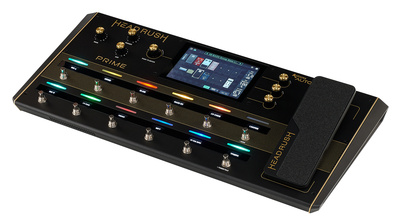
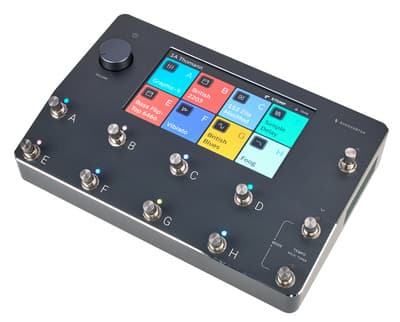
Similar to the Headrush Pedalboard that we tested earlier, the Prime comes in a sleek, black steel case. It measures 63 x 31 x 10 cm and weighs over seven kilograms, making it slightly larger and similarly heavy to the Headrush Pedalboard.
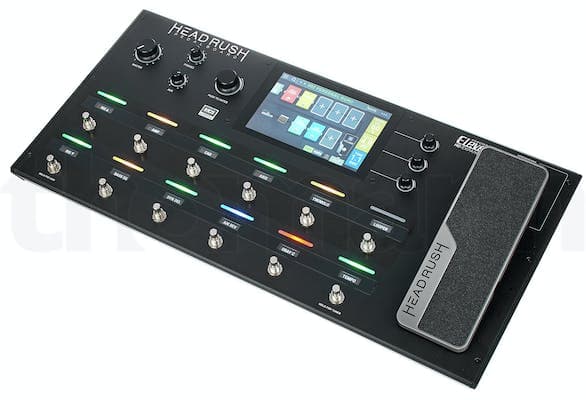
As before, the Prime has twelve footswitches and an expression pedal. At seven inches, the touchscreen display is significantly larger than those of many competitors. Each freely assignable footswitch has a small display for labeling and a colored light strip indicating the assigned effect.
Under the hood is a powerful multicore processor that runs an engine with roots in the Eleven Racks found in Pro Tools. As you would expect, it produces excellent sound.
In addition to its effects and amps, the Headrush Prime features a high-quality looper. As you would expect from a pedalboard, it has a 20-minute recording capacity, which is sufficient for most situations. The looper is a module that can be integrated into the virtual signal chain and changes and reverses the speed of your playing.
In addition to the features you already know from the pedalboard, the Prime offers a training mode. With this mode, you can transfer a song you want to practice to the device and play along with it. You can select a section of the song and play it back at a different speed. You won't need to fast-forward or rewind, and you can practice slowly at first and gradually work your way up to the original speed.
Another new feature is that the Headrush Prime can be loaded not only with existing impulse response (IR) files but also with the sound profile of an external amplifier or effects pedal captured directly. This works surprisingly well, even for novices, as the Prime provides helpful instructions with diagrams showing what needs to be connected where. The multi-effects device sends various sounds to the external amp or pedal and analyzes the returned audio signal. This analysis is used to create a profile that can be integrated into the signal chain like any other virtual device.
Guitarists and singers alike will be happy to hear that the Headrush Prime has a combined XLR/jack microphone input and features Antares Auto-Tune. If you're not familiar with the term, Auto-Tune is a software program often used in professional recording studios to correct pitch.

Connections and Expandability
In terms of connections, the Prime has little new to offer compared to the Headrush Pedalboard. However, this is not a problem since the pedalboard was already well-equipped in this area. In addition to an instrument input, the Prime has an auxiliary connection (mini jack) and a microphone input. The latter is a combination XLR and 6.35 mm jack connector, and the input volume can be conveniently adjusted using the rotary control next to it. There are also two large jack connectors for connecting external expression pedals.
The Prime features a stereo XLR output. It has connections for left (mono) and right, and it can be switched between ground and lift as needed. Unlike the pedalboard, however, there is no longer a physical switch for this. The same applies to switching between amp/line on the stereo output (two large jacks).
Another switch has been eliminated: the one for switching between rack and stomp on the stereo FX loop (four large jacks). Headrush has retained the headphone output on the Prime, but it is now a small jack instead of a large one.
In addition to the standard inputs and outputs, there are also MIDI inputs and outputs. A new feature is the addition of a USB-A port next to the existing USB-B port on the pedalboard. The USB ports allow you to exchange files with your PC, connect MIDI controllers, and use the device as a USB audio interface.
As with the previous model, the power supply is integrated into the housing. Power is supplied via a conventional three-pin IEC connector. Fortunately, an on/off button is also included.
In summary, the Headrush Prime has the following connections:
Instrument input: 6.35 mm jack
Auxiliary input (3.5 mm jack):
Two 6.35 mm jacks for pedal connections
XLR stereo output (left/mono + right):
Stereo output: 2 x 6.35 mm jacks (left/mono + right).
Headphone output: 3.5 mm jack
Two send and two return connections (stereo FX loop).
One MIDI input
1x MIDI output/MIDI thru
One USB-A port
One USB-B port
Three-pin IEC power connector
In our experience, these connections should be sufficient for almost any need. For even more convenient connectivity, the Prime supports both Wi-Fi and Bluetooth. The device can connect to the Headrush Cloud via Wi-Fi. Files can be exchanged with the Prime through the cloud. Bluetooth is mainly used to connect an audio source, such as a cell phone. This feature is particularly useful for owners of new iPhones, which no longer have a physical audio output.
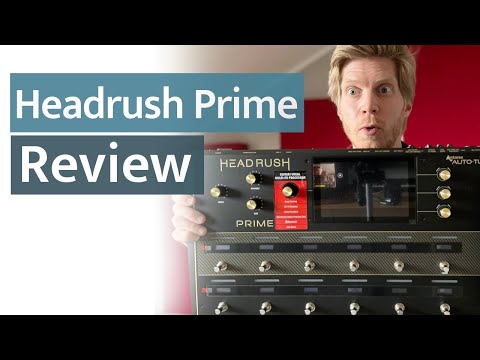
Our video of the test
Amp simulations and effects
The Headrush Prime comes with 53 amp simulations, about a half dozen more than its predecessor. In addition, it has 44 amp models from Revalver. The company is part of the inMusic Group and is known for its realistic simulations.
In addition to the amplifiers, there are 15 cabinets and 10 microphones. As with the amps, HeadRush has added cabinet and microphone simulations from Revalver to the Prime. With 67 cabinets and 31 microphones, the selection is truly impressive.
Since the Prime focuses not only on guitar but also on vocals, it has seven effects specifically designed for vocals. These include the aforementioned autotune, as well as distortion and doubler effects.
Fans of metal and rock can look forward to the usual suspects in terms of distortion and overdrive on the Prime. In addition to the 15 simulations in the overdrive category, the Headrush Prime offers 11 in the distortion/fuzz category.
Ten equalizers, six compressors, twelve delays, six reverbs, seven chorus simulations, ten phasers and flangers, six modulators, seven wahs, seven pitch modulators, four volume pedals, and three noise gates round off the range of effects.
You can also import your own impulse responses. However, the Prime comes with 300 IR files.
Like the Headrush Pedalboard, the Prime's signal chain is highly flexible and adjustable. The individual effect stations can be selected completely freely. Parallel chains are also supported.
Below is a small selection of the included amps and effects:
Vox AC-30 (Revalver amplifier)
Peavey Classic 30 (Revalver amplifier)
Diezel Herbert (Revalver amplifier)
Mesa/Boogie Dual Rectifier (Revalver amplifier)
Budda ZenMan (overdrive)
Boss SD-1 (overdrive)
Boss DS-1 (distortion pedal)
ProCo Rat (distortion pedal)
Dunlop Fuzz Face (fuzz/distortion)
As with the previous model, we really like the sound of the HeadRush Prime. In our review of the Headrush Pedalboard, we noted that competitors offer more amps and effects. Headrush has more than made up for this with the Prime, which now offers an impressive selection of additional Revalver amps and cabinets.
Like some of its competitors, it is now possible to profile or clone the sound of external amplifiers and pedals, which is a great addition to the Prime's already impressive range of features.
Operation
We were impressed by how the Headrush pedalboard operates. It's good to know that Headrush hasn't changed this formula with the Prime. With its touch functionality and large, central color display, the Headrush Prime is one of the best multi-effects devices on the market.
The Headrush user interface is similar to those of popular digital audio workstations (DAWs). Everything works intuitively, from changing the order of effects to renaming profiles to selecting presets.
It's also great that so much of the Prime can be operated exclusively with your feet. Twelve footswitches and an additional expression pedal make this possible. Another well-thought-out feature is that each foot switch is labeled with a display and color code. This allows you to quickly find your way around during operation.
Incidentally, there is no PC software for the Prime. Only a driver for the USB audio interface and a firmware updater are available. However, this isn't an issue, as the standard interface of the Headrush Prime is excellent.
If you want more information before buying, you can download the the manual and quick start guide as PDFs from the manufacturer's website. The manual is slightly more detailed than the Headrush Pedalboard manual and is also very well illustrated.


Conclusion
The Headrush Prime is an excellent multi-effects device that meets professional standards. Compared to its predecessor, the Prime boasts three major new features. First, it has a practical training mode that assists you while you practice. Second, like other high-end devices, it allows you to tap into profiles from external amplifiers and pedals. Lastly, Headrush has significantly expanded its range of amplifiers and cabinets with the introduction of Reverberator simulations.
If you already own a Headrush pedalboard, upgrading may be worthwhile. While the current price of around 1.400 USD (as of May 2023) is not insignificant, it is reasonable compared to competitors. If you're not yet a HeadRush user and have a smaller budget, you can opt for the HeadRush Pedalboard if you can find it. Otherwise, we recommend the new Headrush Prime, which offers more in every respect.
More reviews
Publish date:
Last updated: